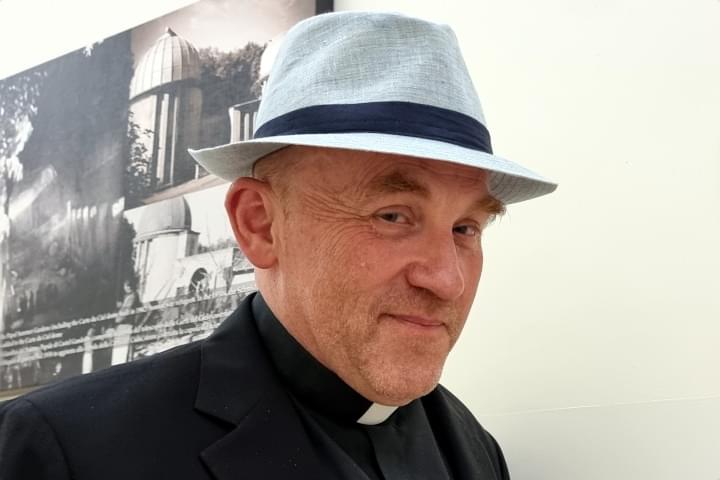
Gabriele Gionti SJ
Science as prayer
I have a great passion for Star Wars, art-house films and pizza margherita. Notebook and pen always on the table, to question the universe.
I am from Capua, the place Spartacus set out from! I received my first telescope at the age of twelve. We
would climb onto the roofs of houses to look at the starry sky: the moon, various planets, Jupiter and the
Galilean moons, Saturn, the Ring Nebula… immense and fascinating. After attending a science-focused
secondary school, I wanted to study astronomy, but I realised I was better suited to theoretical physics. I
graduated in Naples with a thesis on gravity, then completed a doctorate at the International School for
Advanced Studies in Trieste on the quantum theory of gravity.
A long discernment
Several events were fundamental in the growth of my vocation. I was baptised in a church that had first
belonged to the Jesuits and was later entrusted to the Capuchins. During catechism I remember feeling
happy. I shall never forget the freedom of Fr Roberto when he spoke of respect and love for the Muslim
religion. At the parish youth centre I experienced the Lord’s closeness. Then came the turbulent years of
adolescence, secondary school, a Marxist philosophy teacher who claimed that religion was superstition the
search for a new identity, the inability to find firm answers; everything seemed groundless. I was changing
emotionally and relationally. At university I enrolled in physics partly to understand whether studying
science might undermine my faith. On the contrary, the more I studied, the more I understood that the God of
love in whom I believed was compatible with science. I understood this more affectively than through
reasoning. In physics I found people with whom I could share some interests, but I continued to feel the
pressure of society: the idyllic world I had been told about did not work. It was the 1980s. I was confronting
materialism and hedonism and could not reconcile them with what I had experienced as a child. In my fourth
year, during a theoretical physics course, a friend who was discerning his vocation told me about a God who
spoke directly to me and answered my questions. My heart opened immediately. He gave me a book, Prayers
to the Heart of Jesus in the Month of June.
The fall from the horse
“Something began to change. I tried to finish my doctoral thesis. Everything was very interesting, but I came
to realise that the research would lead nowhere. I looked for a second, more competent supervisor, but
feared that this second project of mine would be rejected. The Lord was making me understand that the road
to my fulfilment did not pass through that alone. Despite the serious problems I had with my first supervisor,
because of the pride of both of us, I managed to finish the thesis, and it was accepted. It brought together
quantum gravity and general relativity. But it became clear that science and an academic career were no
longer the centre of my life, nor could they, by themselves, fill my heart.
Searching online for my true vocation
Other questions were beginning to emerge. Which vocational path should I choose? Marriage? Consecrated
life? I was thirty. I searched online: I moved from the Dominicans’ website to that of the Franciscans, and so
on. I felt that religious life might suit me. I reached the website of the Italian Province of the Jesuits, then
created by Fr Francesco Tata. I was attracted by their spirituality. A book by Teilhard de Chardin helped me understand that the Catholic Church reflects on matters that are far from trivial and is able to offer profound answers. In the past I had had the impression that the Church gave pre-packaged, dogmatic answers without taking contemporary culture into account in the slightest.
In Naples I went to the Church of the Gesù Nuovo. I contacted Fr Sibilio, then Vice-Provincial for the South.
He entrusted me to Fr Armando Gargiulo, who had been the first Provincial of Italy. In the meantime, I won
a postdoctoral fellowship at the University of California, Irvine. An American Jesuit accompanied me there
in spiritual direction. I returned to Italy for the Spiritual Exercises in Naples at the house in Cappella Cangiani. I spent a period of service caring for the sick. Fr Sibilio also introduced me to the Vatican Observatory. On 4 October 2000 I entered the novitiate.
A winding path
I experienced some tensions in community life because of the different ages and backgrounds of those
present. I gradually matured humanly and emotionally. I still had questions for which I had found no
answers. I lived through the years of philosophy, then two years of regency in Tucson, Arizona, with the
Vatican Observatory, and four years of theology, three in Berkeley and one in Naples. It was a long road, full
of ups and downs, in constant dialogue with my Superiors.
By then my dreams of vainglory had been unmasked and my vision of the world had changed profoundly. I
had previously thought that vocation depended greatly on me and on my decisions, in the continual attempt
to reconcile personal interests and possible paths, while in reality fearing total surrender. Now I was aware
that it is God who chooses, giving you a gift. Emotional maturity enabled me to give things their proper
weight, according to their value, in the awareness that the Lord’s call is worth more than any dream one
could have. I was helped by prayer, the Spiritual Exercises and an attentive reading of the events of life
through which God speaks to me and which tell me how things truly stand.”
Contemplating the heavens
Fifteen Jesuits are involved in astronomy and astrophysics research at the Observatory: eight in Castel
Gandolfo and seven in Arizona. It is a service entrusted to the Society by the Pope in 1906. Research activity
is preceded each morning by prayer. Then come the reading of articles, writing, and contact with fellow
scientists. We do not teach, so we have more time for research, but also fewer stimuli and questions to
provoke it.
Then there is community life: coffee at ten, meals, Mass at seven in the evening, and ministry to the
prisoners in Velletri prison.
Every now and then our gaze returns to the sky. The Observatory domes open, and powerful telescopes carry
our gaze far away.
We are studying the first instants of the universe after the Big Bang, when the universe is thought to have
been as small as a point, dense and at extremely high temperatures. The speed of light is 300,000 kilometres
per second. We hypothesise that its maximum speed in those instants was zero.
Science as prayer
To seek and find God in all things. This is the final exercise proposed by Saint Ignatius in the Spiritual
Exercises. Scientific research is precisely this search for the laws by which God works in nature, in which his
Son became incarnate, as is said in the Contemplatio ad Amorem. In this way science becomes a prayer and a
means that helps men and women draw closer to God. Gazing into the universe reminds me that we are not
the centre, that other realities, civilisations and forms of life are possible. It tells me of the beauty of this
earth, which we risk ruining, and restores the wonder present in the cosmos, creation and its incredible order.