Sergio Sala SJ
His plan was more complete than mine
I first encountered the Jesuits when I was 18. A summer camp in Selva di Val Gardena, followed by three days of Spiritual Exercises, changed everything.
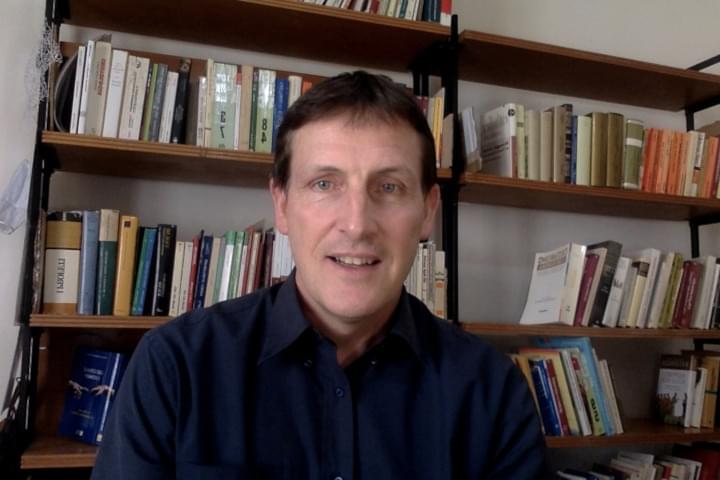
I was born in Vicenza in 1968. From the Veneto I carry with me a stubborn head and the accent. Wherever I may be, the way I speak betrays my origins, rather like Peter in the courtyard of the high priest. As a convinced supporter of the principle of inculturation, I would like to be able to blend in more with local people, but there is no way; fortunately, becoming inculturated does not mean renouncing one’s origins, but trying to understand, accept, value and integrate the new culture with which one finds oneself living. It is one of the values I learnt from my most precious family, with whom I enjoyed a peaceful and carefree youth.
Meeting the Jesuits and the long discernment
At the age of eighteen I first encountered the Jesuits. A summer camp in Selva di Val Gardena followed by three days of Spiritual Exercises changed everything: a new vision of God, of life and of myself. Outwardly, I continued with the same very varied life as before—much study, the first part of the evening in the parish or district council, the second with friends, various forms of voluntary service and fundamental emotional experiences—but inwardly something had changed, and those who knew me noticed it.
When the time came to decide what to do with my life, that encounter proved too important. Connecting it with other signs the Lord had scattered along the way, I felt that this was a call to religious life. Yet another ten years passed before I entered the Society: I would have liked to retain all the benefits the camp in Val Gardena had given me without accepting its burdens. Only after admitting to myself that God’s plan was more integral and complete than mine—in boxing terms, only after I had “thrown in the towel”—did the path become simpler. Obviously, problems are not lacking even now, but the point is not to avoid problems; it is to face them with the necessary calm and strength.
Chemistry studies and international volunteering in Brazil
Before the novitiate, there had been two important formative chapters in my life: chemistry studies and international volunteering. The fascinating quest to explore the infinitely small has helped to reveal the infinitely large, and university has given me a certain methodical approach that I know how to draw on when needed. The two and a half years in Brazil were a wonderful training ground for life: I lived in a small town surrounded by a sea of sugar cane and worked in a youth centre surrounded by a sea of children. Among the many experiences, the one that left the strongest mark—unexpected and slightly risky—was in the field of agrarian reform: preparing and accompanying the occupation of mortgaged, uncultivated land. On returning to Vicenza, I tried to go back to “normal” life, but by then I was well and truly ready, so I resumed contact with those who would soon become my brothers in the Society.
Formation in the Society
The long years of formation in the Society passed in an instant. This paradox is popularly translated into phrases such as “Time flies” or “It seems like yesterday”, and is generally considered a sign that things are going well. They were very intense years, so much so that merely listing the experiences I had and the people I met would exceed the maximum space allowed for this presentation.
On the other hand, my curiosity and the vast wealth of human and cultural knowledge that a Jesuit education provides have produced a highly enjoyable mix, with the sole risk of getting carried away – that is, of taking time away from rest.
Theology was fascinating, and although we complain—sometimes rightly—that certain courses ought to be reformulated, the academic level remains high. Among the various disciplines I favoured biblical theology and Christology, while I found moral theology burdensome. Yet when, for apostolic reasons, I found myself caught between the hammer and the anvil of a bioethical problem, I was grateful that my studies in the morality of physical life were still fresh. At that moment I also felt the importance of ongoing formation once basic formation has ended. The problems people face are such that one ought to know a little about everything, and since this is impossible, our great resource is networking, a subject on which formators insist.
From Brazil to Scampia, from Sri Lanka to Reggio Calabria: old and new forms of poverty
I had the good fortune to return to Brazil to complete my licentiate studies while taking my first steps as a priest in one of the many parish communities served by the Jesuits on the outskirts of Belo Horizonte. On returning to Italy, my first long-term apostolic experience began in Scampia, in the Naples hinterland, where I lived for ten years until 2019, interrupted by six months of tertianship in Sri Lanka.
I currently work in Reggio Calabria, with attention also to the Gioia Tauro plain and the Locride area. Together with my Jesuit companions and lay brothers, we carry out a varied apostolate addressed to people of every age and background, which I would sum up in a single word: “welcome”, the style and goal of every formative and pastoral action. We welcome the penitent in the confessional and the undocumented migrant, the agnostic seeking meaning and the prisoner who lacks understanding…
Amidst the variety of paths I have taken, one common thread remains: an interest in both old and new forms of poverty. I have worked with people struggling with drug addiction, those living with AIDS, migrants, Roma, and others in need. My regency at the Secretariat for Social Justice and my involvement in the training programme at the Jesuit Social Network have been fundamental in helping me to reflect on the causes that lead these groups to suffer.
Networking
In order to carry out quality work, it is necessary to hold together three levels of intervention: with people, especially the most vulnerable; with the associations that care for them; and with institutions, which are very important for solving problems yet at the same time find themselves in profound crisis. It is our task to try to be of help without ever replacing social services, school or family.
As experiences increase, responsibilities increase too. I accept with a certain heaviness the fact that one cannot have the former without the latter, always grateful to the Lord for the vocation to religious life.